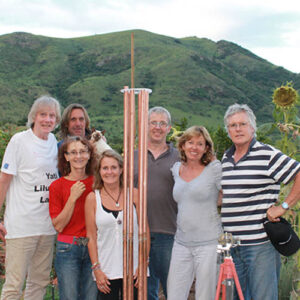
Your fantastic Orgonite Cloud Buster needs help
Putting up a Cloudbuster does not eliminate the necessity to neutralise all cell towers in a wide area…

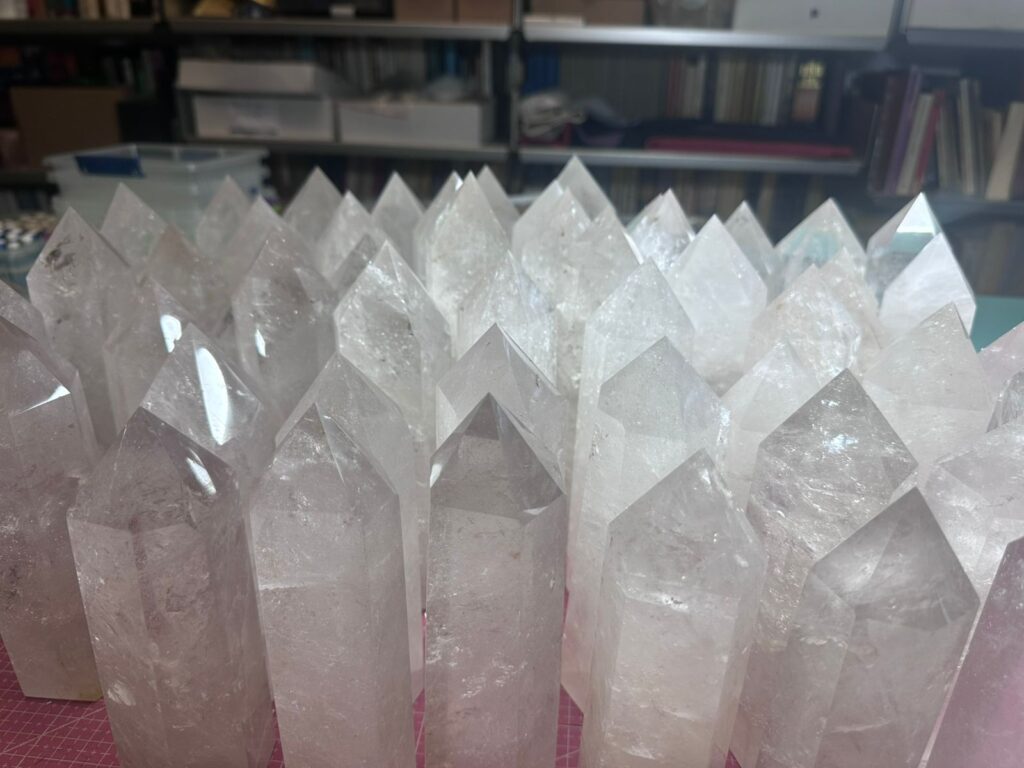
Something interesting has been happening in the orgonite world over the last couple of years, and I feel it is time to address it directly.
If you have spent any time on TikTok or Instagram recently, you have almost certainly come across a very confident explanation for how orgonite works.
The argument goes something like this: when you cast a quartz crystal in polyester or epoxy resin, the resin contracts as it cures, squeezing the crystal.
That squeeze creates the piezoelectric effect — an electrical charge — and that charge is what neutralises the DOR and heals the atmosphere around the device. It is a clean explanation. It sounds scientific. It references a real physical phenomenon.
And it is spreading rapidly — one account alone has accumulated over 64 million views on TikTok with variations of this argument as their core message.
I understand the appeal.
After 24 years of trying to explain orgonite to people who want a conventional physics answer, I genuinely sympathise with anyone who reaches for a mainstream framework to make the conversation easier. But this explanation is physically wrong.
And because so many of you have been writing to me about it — some confused, some enthusiastic, some asking whether you should be adding more crystals to your pieces — I want to walk through exactly why it does not hold up, and what the actual mechanism is.
| “People are trying to explain orgone effects with conventional physics rather than embracing the idea of ether physics, where the interaction is really an etheric one.” |
| The problem with the static squeeze The piezoelectric effect is real. It is well-documented and widely used in engineering. The one most of us still remember is the crystal needle in early record players. The vibrating needle would trace the groove of a rotating record, and that vibration was mechanically coupled to a small quartz crystal. T he needle’s movement compressed and released the crystal dozens of times per second — at acoustic frequencies, 20 to 20,000 times per second — and that rapid, alternating compression produced an alternating electrical signal that was an accurate mirror of the original sound. Notice what made that work: dynamic, continuous change. The crystal was being compressed and released, compressed and released, over and over. The piezoelectric effect in that device was real because the mechanical stress was never static. It was always changing. |
| T H E P H Y S I C S P R O B L E M Piezoelectricity requires a change in mechanical stress to generate an electrical charge. A crystal held in fixed, unvarying compression — the way cured resin holds it — produces a one-time charge at the moment of compression, which then dissipates within seconds as leakage currents neutralise the surface potential. No material is a perfect insulator. The resin does not continuously squeeze the crystal. It has already squeezed it. That squeeze is now finished. |
This is the critical distinction that the piezoelectric orgonite argument misses entirely.
When your resin cures around a crystal, it does contract — that much is true.
And at the moment of that contraction, a surface charge is induced on the crystal faces.
But the curing process is not continuous. It finishes. The resin hardens.
The compression stabilises. And once the stress state is static –once dF/dt equals zero, as a physicist would put it — there is no further electrical output.
The charge that was briefly generated dissipates almost immediately through atmospheric humidity and the resin’s own very low but non-zero conductivity. What you are left with is a crystal sitting in a fixed mechanical state, producing no measurable ongoing electrical current.
That is not how a continuously operating energy converter works. That is how a charged capacitor behaves when you disconnect it from the power source — it holds a potential briefly, then goes flat.
The Proof That Was Always There
Here is what I find most remarkable about this whole conversation, and why I believe we do not even need to get deep into the physics to settle it.
The original inventor of orgonite — Karl Hans Welz, who coined the term and held the trademark from the mid-1990s — did not use any crystals at all.
Welz’s original orgonite formulation was exactly what the name implies: organic resin and metallic particles, mixed together.
No quartz. No gemstones. No double-terminated points.
He created his orgone generators using that bare matrix alone, and those devices were functional enough for him to build an entire product line around them, file for trademarks, and produce documented results.
Don Croft, who is largely responsible for the wide dissemination of the gifting movement, later added quartz crystals to the basic matrix — and that is the form most people are now familiar with.
But here is the logical consequence that the piezoelectric argument cannot escape: if crystals are the source of the orgone effect, and if the piezoelectric compression of those crystals by the resin is the mechanism, then Welz’s crystal-free orgonite should have produced nothing at all.
It should have been an inert block of plastic and metal shavings. It was not. Which means the crystals are not the source of the primary effect, and the piezoelectric compression of those crystals cannot be responsible for the DOR-to-POR conversion that we observe when orgonite is placed near a transmitter.
| “Orgonite works without crystals. Therefore the piezoelectric effect, whether it occurs or not, cannot be responsible for the basic conversion of DOR to POR.” |
What is actually happening?
Wilhelm Reich’s early observations — the ones that led to his development of the orgone accumulator — established something straightforward: metal attracts and immediately repels orgone energy, while organic material absorbs and accumulates it.
That asymmetric behaviour between metallic and organic layers was the entire basis of his accumulator design, where alternating sheets of metal and organic material created a directional concentration of orgone in the enclosed space.
Orgonite takes that principle and scales it down to a microscopic level. By chaotically mixing metal shavings and organic resin — not in orderly layers but in random dispersion — you create millions of microscopic boundaries in every direction.
Every metal particle is a point of repulsion. Every resin surface is a point of absorption.
The energy cannot travel through this matrix in a straight line; it is constantly being pulled in and bounced back, absorbed and reflected, at a scale so small that the effect is continuous and omnidirectional.
This is what re-accelerates stagnant energy. DOR, in Reich’s framework, is not a different kind of energy — it is orgone energy in a state of stagnation, locked and rigid, caused by microwave transmitters, nuclear materials, artificial electromagnetic saturation, or other environmental stressors.
When this stagnant energy passes through the chaotic metal-resin matrix of a piece of orgonite, the constant alternation between reflection and absorption breaks down that rigidity. It restores velocity. It restores mobility.
The stagnant standing wave is forced into motion — and motion, in the Reichian biophysical sense, is exactly what healthy orgone looks like.
This mechanism requires no crystals. It requires no electrical charge. It requires only what Welz understood from the beginning:
Organic material and metal particles, together, in sufficient density and randomness.
So, what are the crystals for?
I want to be precise here, because I am not saying that crystals add nothing. They do add something — but it is not what the piezoelectric argument claims it is.
The resin-metal matrix is, in a sense, a turbulent engine. It generates re-accelerated energy in all directions, without structure or directionality.
A quartz crystal, embedded in that active field, introduces a highly ordered geometric presence — the hexagonal lattice structure of silicon dioxide is one of the most stable and coherent crystalline structures in nature.
What the crystal does is act as a coherence template, a waveguide that imposes structure on the turbulent output of the matrix. The re-accelerated energy is given a pattern to follow, a geometry to align with. The result is a more focused, more structured output — the same engine, but with a directing mechanism added.
This is also why different crystals produce observably different qualitative effects in a piece of orgonite. They are not generating the energy.
They are shaping it. They are adding an information layer, if you want to use that language — and in my experience, that is a meaningful addition. Just not the one being claimed in the piezoelectric argument.
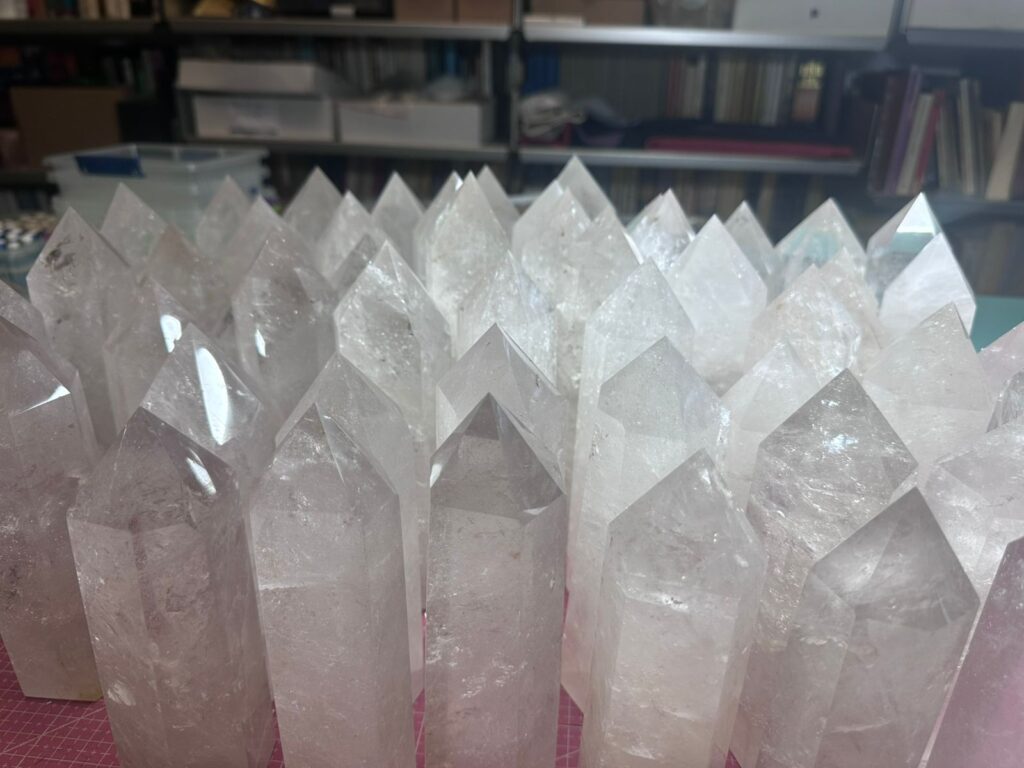
beautiful quartz crystals that we use in our orgonite power wands
Why this matters beyond the physics
I want to be honest about why I find this trend troubling, beyond the simple matter of physical accuracy. We have spent 24 years building a community of people who understand that the etheric reality of their environment is real, and that the tools we use to influence it operate according to principles that mainstream physics has not yet caught up with. That has always been an uncomfortable position. It puts us outside the consensus. It invites ridicule from certain quarters.
But the relief is purchased at a cost. The piezoelectric explanation works by reducing orgone to electrostatics. It makes DOR and POR invisible, because those concepts have no place in the framework being offered.
It removes Wilhelm Reich from the picture entirely, along with everything he observed and documented about the behaviour of life energy. And it creates an incentive structure — in the commercial orgonite market especially — to load devices with as many crystals as possible and charge accordingly, because if crystals are the mechanism, more crystals means more piezoelectric output, which means a more powerful device.
That is not how it works
A beautifully decorated quartz-filled pyramid with inadequate metal-to-resin ratio is not a more powerful device. It is a decorative object.
The people most at risk from this confusion are exactly the people who are most enthusiastic about orgonite — newcomers who are genuinely trying to understand what they are working with, and who deserve an accurate picture of the mechanism so that they can use these tools effectively.
Ether Physics – a better framework for understanding orgonite
What we are working with is ether physics. That is not a comfortable phrase in 2026. It was not comfortable in 1948 when Reich was writing about it either. He was describing an omnipresent biological energy, the same energy that Chinese medicine calls chi and Indian medicine calls prana, that has properties quite unlike anything classical electrodynamics describes.
It moves in patterns. It stagnates. It can be accelerated. It responds to materials in ways that are consistent and reproducible, even if the mechanism is not yet formalised in a university textbook.
I do not need mainstream physics to validate what 24 years of field work and tens of thousands of gifted towers have demonstrated. But I also do not want to see the community’s understanding of that work replaced by an explanation that is both scientifically incoherent and historically inaccurate. The piezoelectric effect is real. Its application to cured-resin orgonite as a continuous energy source is not.
“The metal-resin matrix is the engine. The crystals are the waveguide. The ether is what moves through it”
Every tower that gets gifted, every Cloudbuster that goes up, every piece of orgonite placed near a transmitter — it all adds up. We have seen what it does to landscapes, to weather, to the sky above our heads. Keep going!

Ready to experience orgonite for yourself?
Shop All Products →
Putting up a Cloudbuster does not eliminate the necessity to neutralise all cell towers in a wide area…